
Most agencies are matching services. We’re a real team.
We employ our doulas. Everyone is certified and receives ongoing professional development and training. We back them up. The result is care that’s consistent, accountable, and designed for the work to actually be sustainable for the people delivering it.
Start hereNot a contractor model.
This isn't a matching service.
Most doula agencies are matching services dressed up as something more. You pay them a fee, they introduce you to a contractor, and from there you’re on your own. The doula is responsible for her own training, her own schedule, and her own backup plan — or no backup plan at all. If she gets sick, overbooked, or burned out, you’re the one scrambling.
We don’t operate that way. Every Doulas of San Diego doula is a W-2 employee. Postpartum doulas have set hours, paid administrative time, PTO, and continuous training paid for by the company.
Quality control is a real thing, not a marketing line.
A matching service or cheaper agency introduces a family to an independent contractor and then steps back. That contractor sets her own training standards. Manages her own backup, or doesn’t. And has no real accountability to the agency if something goes sideways. If the fit is bad — wrong personality, inconsistent quality, missed shifts — your only options are confronting it postpartum, eating the cost, or finding someone new at the worst possible moment.
Every doula on our team is a W-2 employee of Doulas of San Diego. She receives ongoing professional development so she's always growing and learning as a doula. Her performance is supervised. Her standards are consistent across every family she serves. If a shift isn’t right, we fix it. You aren’t hiring a person and hoping for the best. You are hiring a company that stands behind its people.
Labor and postpartum are different specialists, on the same team.
Many cheaper options offer one doula for both labor and postpartum, framing the single point of contact as a continuity advantage. In practice it creates a structural conflict. A doula on call 24/7 for clients in active labor cannot also be reliably scheduled for postpartum overnight shifts the same week. The result, in the worst version of the story, is a labor doula who is exhausted from an 18-hour birth walking into the newborn’s first overnight at home — or not coming at all because another client went into labor.
We separate the two roles deliberately. Your labor doula specializes in birth. Your postpartum team specializes in the six weeks after. The labor doula briefs the postpartum team in writing before they arrive, so the information is continuous even when the people are not the same. The result is a specialist at each stage, not a generalist stretched across both.
A lower price on a different model is not a better deal. It’s a different product.
The team-and-employed-doula model has a cost. It is also a measurably different product than a solo contractor at a lower hourly rate, and the difference shows up in exactly the moments families are least equipped to handle it.

Why six weeks?
Why six weeks isn’t an arbitrary package length.
The first six weeks after birth are one of the most intense and under-resourced transitions families go through. Most mothers are sent home after delivery with limited guidance and a single follow-up appointment at six weeks — while simultaneously navigating physical recovery, feeding a newborn, severe sleep disruption, and a hormonal landscape that changes dramatically day to day. Questions are constant, confidence is low, and partners are still learning how to help.
We bridge the gap between hospital discharge and your six-week checkup with overnight care that compounds in value as the weeks progress. Here is what that actually looks like:
Week one is triage. You've just come home from the hospital, where you had round-the-clock nursing care. Now it's just you. Physically, your body is recovering from birth. If you're breastfeeding, your milk comes in between days three and five — and there is a significant learning curve that catches almost every first-time parent off guard. If you're bottle feeding, you're figuring out which bottle and formula works for your baby. Your doula is by your side through all of it — troubleshooting feeds in real time, watching for early signs of issues before they become problems, and establishing a mental health baseline for you so that any shifts in the coming weeks don't go unnoticed. She is also simply getting to know your household, your baby's temperament, and your rhythms. The work this week is stabilization.
Week two, the hormone drop arrives. Estrogen and progesterone fall sharply after birth, and this is typically when baby blues emerge — up to 80% of new mothers experience postpartum blues, usually peaking around day four or five and lasting up to two weeks. Your doula knows this is coming and is watching for it without alarming you. This week also carries a clinical weight: your pediatrician will want to see your baby back at birth weight, which means feeds are under a microscope. Your doula is tracking ounces, intervals, and output every night and can flag concerns before your next pediatric visit rather than after it.
Week three, something shifts. Your doula knows your baby. She knows which soothing technique works at 2am, which feeding position your baby tolerates, and what your household needs before you've asked for it. A rhythm has begun to unfold — and this is the week she starts doing something that matters beyond the overnight: she begins helping your baby learn to sleep in longer stretches in the bassinet, and she teaches you which techniques your specific baby is responding to. On the nights she isn't there, you have something to work from. You are not starting from scratch anymore.
Week four, the learning lands. You are sleeping well enough to actually absorb what has been happening around you for three weeks. The information your doula has been sharing since week one — about wake windows, hunger cues, feeding patterns, what is normal and what isn't — starts to click in a way it couldn't when you were running on two hours of sleep. This is often the week families describe as a turning point. The fog begins to lift. You start to trust your own read on your baby.
Week five, you are finding your footing. Neither parent is completely sleep deprived anymore, and that changes everything. The knowledge and instincts you have been building over the past four weeks start to feel like yours — because they are. Your doula has not been the one running the show; you have. She has been the expert in the room on the nights you needed rest, and the teacher during every handoff. This is often the week mothers first feel a version of themselves returning — and most recognize, clearly, that the sleep they've been protected made that possible.
Week six is an intentional exit, not a cliff edge. Some families arrive here ready to move forward independently. Others realize their baby's temperament or their own recovery calls for a little more time, and they choose to extend. Either way, you don't just finish — we help you think through what comes next. If you're continuing, we build the right taper plan. If you're wrapping up, we help you map what your evenings look like without overnight coverage, which resources to have on hand, and who to call if something comes up. You leave with a plan, not a gap.
A two-week package delivers triage. A six-week package delivers transformation.
The distinction matters because what happens in those last three weeks is the part most families remember, and the part that determines how the rest of the early postpartum stretch goes.
There is a second cost worth naming. Families who under-invest in the postpartum period often find themselves hiring a sleep consultant, an additional lactation specialist, or a perinatal therapist afterward — to address what wasn't caught or stabilized in the early weeks. Those costs are real, and they rarely show up in the original price comparison. A fuller package up front is often less expensive than a shorter package plus the downstream specialists hired to fill what the shorter package missed.

Ready for your actual due date, not the one on the chart
We’re operationally ready for whenever your baby actually arrives.
Cheaper packages and solo doulas are usually booked around an estimated due date with limited flexibility built in. Babies arrive when they decide to.
Our model is built around that reality. Your postpartum team is briefed and ready in the weeks leading up to your due date. The Doula Connect schedule shifts based on your actual delivery date — early, late, or scheduled. Care begins within 2–3 days of your hospital discharge regardless of when that is.
What this means in practice: you are not booking a reservation that pretends the baby kept the appointment. You are retaining a team that is operationally ready for whenever you actually come home from the hospital.
The alternative is the version of this story that plays out for a meaningful percentage of families with solo doulas: baby arrives at 38 weeks, the doula has another client in labor or is on a different schedule, and the family is making urgent, stressful decisions about coverage in the exact window they are most vulnerable. Our entire model is structured to take that scenario off the table.

Certified, screened, and continuously educated
Every doula, deeply trained — and always learning.
Every doula on our team completes Pro Doula certification, which is rooted in evidence-based, non-judgmental training. To hold their certification, every doula maintains current CPR and First Aid credentials. Before anyone joins our team, they complete a full background check and reference check. Once they’re on, they complete our internal training library — covering the situations new families actually face, not the textbook version.
What our training specifically covers:
- Feeding in every direction. Breastfeeding, bottle-feeding, combo-feeding, supplemental nursing systems (SNS), pumping, and the learning curves that come with each choice.
- Sleep and soothing. Safe-sleep practice, settling techniques, Snoo handling, wake-window patterns, and when to escalate to a sleep consultant.
- PMAD recognition. Perinatal mood and anxiety disorders. We can help you understand the difference between baby blues and something that may need clinical attention, and flag concerns early to you directly.
- Physical recovery triage. Normal postpartum bleeding, signs of infection, pelvic floor concerns, and when something warrants a call to your OB before your six-week visit.
- Scope awareness. Doulas are not medical providers, and our team is trained to know exactly where their scope ends and when to loop in your OB, midwife, pediatrician, IBCLC, or pelvic floor PT.
Vaccination — annual disclosure plus client-side matching
Every doula’s vaccination status is on record. You tell us what you need; we match accordingly.
We require every doula on our team to disclose her vaccination status annually for four vaccines: flu, Tdap, COVID, and MMR. Status is updated and re-recorded each year so the data is current, not historical. We do not impose a single universal vaccine requirement across the team — we hold the data and do the matching.
If you have specific vaccination preferences or requirements for the doulas in your home, you tell us on the inquiry form and we match you accordingly. Many of our families, particularly those in medical-family households, treat vaccine status as a hard gate — and for those families, knowing that every team member’s status is annually disclosed and that we actively match you to doulas who meet your requirements is a stronger trust signal than a blanket mandate would be. You are not relying on a one-size policy. You are relying on full transparency plus a real matching process.
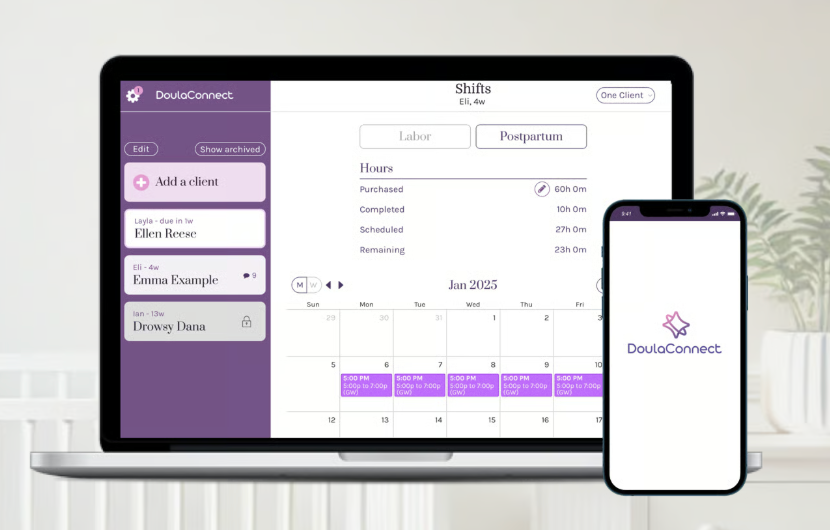
Tech-enabled, human-led
Doula Connect, our care-coordination app.
Doula Connect is where your overnight schedule is pre-planned around your due date and shifted once your baby arrives. Each morning, you wake up to timestamped shift notes — what time feedings happened, ounces taken, sleep stretches, anything noteworthy. You can chat directly with your doulas in the app, and every resource we share — handouts, checklists, local referrals — lives in one place you can always find.
Technology makes our team better. It doesn’t replace them. The work itself is always human, in person, and at your bedside.
